


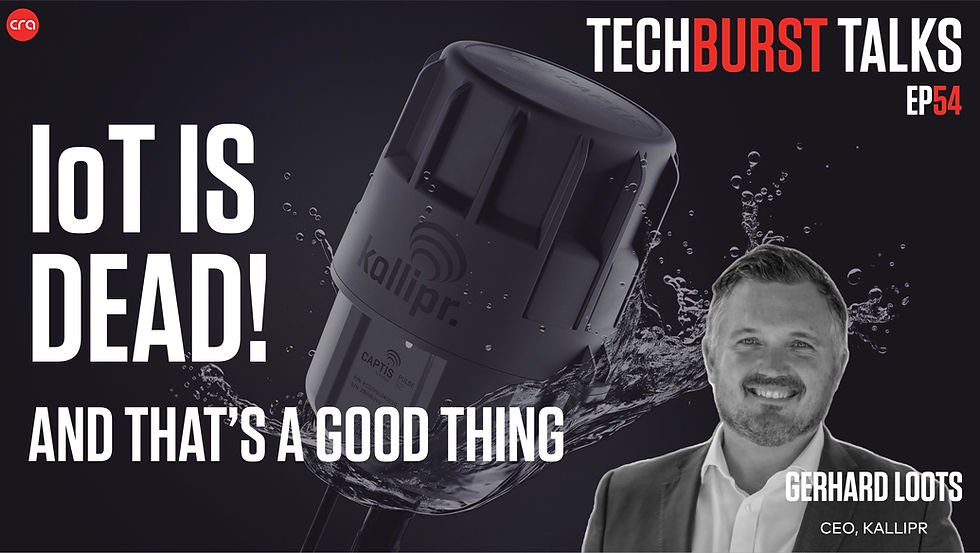


CEO, Kallipr
Location: Brisbane, Australia
Forget the hype. IoT isn’t about flashy pitches — it’s about solving real problems.
In this episode, Gerhard Loots shares his journey from leading IoT at Telstra to building Kallipr into a startup reshaping industries. We talk practical sensor solutions, cost of ownership, and real-world deployments in rail and water.
The discussion ranges from India’s growing influence in tech, to the role of satellites, to how AI can transform infrastructure management. Gerhard also opens up about Kallipr’s future vision: digitising the physical world in ways that actually deliver value.
A straight-talking look at IoT — stripped of buzzwords, focused on outcomes.
IOT RE-IMAGINED: PRACTICALITY OVER PROMISES - GERHARD LOOTS


WATCH ON YOUTUBE
LISTEN ON SPOTIFY
60-SECOND INSIGHTS
MORE ABOUT GERHARD:
MORE ABOUT KALLIPR:


FULL TRANSCRIPT
CRA: [00:00:00] Gerhard Loots, welcome to the Tech Burst Talks podcast. Gerhard Loots: Thanks, Charles. It's great to be here and talk again. CRA: It's been a while. Last time you were on the podcast was back in 2019, and that's when you were still with Telstra running the IOT business . But for you, a lot has changed since then, and I guess for all of us, so what have you been up to the last five years? Gerhard Loots: Yeah, I can hardly believe that it's been five years, Charles, but I've joined a company called the Madison Group in 2021 after Telstra as CEO the group has been around for about 30 years with divisions in audio industrial communications cabling and also LTE infrastructure. And one of the companies that fits in under that umbrella, a company called Kallipr previously used to be known as MIOT. Kallipr is very focused on developing IOT solutions. And in the last three months I took the role of Kallipr as a primary focus and I'm no longer leading MGE. And we're trying to take Gallup global at this point. CRA: Now, I find this [00:01:00] interesting because you left the relative comfort of a large corporate of working for Telstra, the incumbent operator in Australia, and you've gone to much more of a startup. So what led to that transition? Gerhard Loots: I think there's seasons in your life, Charles. And I think, I had the opportunity to lead a really good team at Telstra and we did some really amazing things, but yeah, it probably got to a point where it was time to move on and I'm very grateful for all the opportunities that Telstra gave me and all the people that I've met along the way. So I decided to take on a new challenge and yeah like we've said before. Even the large corporates aren't necessarily that comfortable at this point anymore either but you know a little bit about that too, don't you? CRA: Oh yeah, I've I'm X three telcos, so I'm XO two Vodafone and bt, I always say it tongue in cheek. I'm curious why people leave telcos, but I always understand why they left telcos. So they're a great place to be at. You can learn a lot, but sometimes need to go out and have some more impact. But what I'd like to do now is find out a little bit more about Kallipr and your solution. So what does Kallipr do? What are the products that you provide and services to the [00:02:00] market? Gerhard Loots: Yes, a Kallipr is a play on the name of a Kallipr that uses a measuring tool. Kallipr is the product said that we have consists of the ability to measure things in new places. So physically it comprises of hardware that uses battery powered or energy harvesting techniques to connect to a wide range of sensors. Some of them we build ourselves. Some of them we just use off the shelf, depending on whether we can meet the use case and the feasibility with it. And what we do then is we take measurements and upload that measurements into the cloud and generate some insights from there. I think the thing that makes Gallup a special though, is that we're completely vertically integrated all the way from manufacturing to getting the machine learning patterns defined in our cloud itself and back down again to the edge devices. Yeah, we've been going for about seven years as a company and yeah, the last three years we've really pushed on building a new. product platform, which is the Kallipr S2 series, which [00:03:00] from our point of view, is the leading solution in the market. CRA: So I want to come back to some of the use cases in a bit, but I want to first hit on this because this is one of the big questions I had when I first heard that you were going to join Kallipr. You're manufacturing your own pieces of kit as well, and developing the software. And you're based in Australia, up in the Gold Coast, which, as we can see, it's a little bit cold there right now. Whereas it's very hot in Singapore. How do you compete in that? Because a lot of the sensors that we see come out of China, they're dirt cheap. So what are your differentiators against the people who come from more the low cost manufacturing countries? Gerhard Loots: Because I think it starts off with, you have to be thoughtful in your design process and consider which components you place on a device. And that can really make a difference on your bomb to start off with. But, even having done that, there's obviously other companies that will do the same. I'll focus as a company really is looking at the total cost of ownership of a solution. And what I'm, what I mean with that is just that, if you've got a cheap device that can last for a year or two, you're going to Which is relatively easy to build and [00:04:00] design. Yeah, then after a year or two, that has to be replaced, and that has a costly implication for the customer. As a company we focus on three things. Yeah, the first thing we focus on is to reduce the cost of deployment. Yeah, by Paying a lot of consideration to things like mechanical design, but also things like staging and, automating some of the functions that has to be done manually. Secondly, we focus on, increasing the longevity of the solution. We've got market and industry leading battery life claims on our devices. That, that is not coming with a lot of asterisks and so forth, so we're it's an honest claim. And then thirdly we try to reduce the maintenance cost and specifically we are extremely focused on truck rolls and, yeah, and making sure that when when a solution goes out to market, that you don't need to visit that too quickly. CRA: See, a couple of years ago, we caught up in Singapore and you started talking about truck rolls and I'll be honest. I didn't know what a truck roll was or how high the costs are of doing truck rolls and how that totally impacts the cost of ownership of a [00:05:00] solution. So I really like the idea that you're focusing on that because what you're doing is really delivering more human outcomes to more different potential influencers in the decision process. And the way I looked at it was you've got a great piece of kit that you're actually taking to market that is industry best in class as far as the quality of the tech spec in the kit. But then what you've done by focusing on the total cost of ownership. is you're addressing the concerns and challenges of other people that are involved in the decision making process. And if companies don't do that and they just focus on the tech, they miss out on that. But because you're bringing those people in and addressing those concerns, I'm sure that streamlines your sales process and makes it easier for people to adopt your solutions because, let's face it, if there's a major investment, they want to see that there's going to be a quick ROI. And because of your focus on reducing that total cost of ownership, that gives them that quick ROI. Gerhard Loots: Yeah, I'll give you an example. So we're working with a city in North America and one of the challenges I have is when they have to open a manhole cover, they have to shut down streets that has [00:06:00] trams and electric buses in it. And the process of shutting that down, and this is their number, it's not ours, costs 30, 000. Yeah, just to shut down things. And yeah, then you're looking at putting a solution in there. That's 000. The cost of opening the manual cover is 30, 000. So if your solution isn't built to last for the maximum period of time, in that instance, yeah, the 30, 000 becomes a hell of a lot more than yeah, than whatever the devices could cost. That is a bit extreme. I acknowledge that, that we haven't seen that too often, quite often, even if you think in the city context, it is usually if you need to open up a manual cover quite often, there needs to be two or three people from a health and safety perspective that have to be paid. It's, that cost adds up so quickly. And I think the thing that we look at and what we try to communicate to our customers is. Beyond just the actual cost, that it doesn't really add value to, to spend that much time changing a battery or, go visiting a manhole just simply because the [00:07:00] design wasn't done correctly from day one. CRA: Very good. You can tell them I'll do it for 20, 000. So maybe I'll save them 10, 000. I can just do a few of those a week and then I'll be done retiring about a year. I think that'll work perfect for me. And I don't care about health and safety, I'll manage. So Okay, anyway, so what about some other use cases now? You've mentioned with the manual coverage, what are some of the other successful case studies that you have of clients that you've delivered to? Gerhard Loots: I'll start off with rail because rail is such an easy one to understand. If we look at, if we look at rail networks they're quite big. And there can be thousands of kilometres, but the amount of data that comes off the rail network is very restricted. And I think when we look back at, infrastructure management in 50 years time, I think we're going to feel quite similar to looking back today at how they landed on the moon for arguments. I still can't believe that they did it with so little compute power, but yet they did it, and I think people are going to look back in 50 years time and say, look, but is this infrastructure really had no data coming from it? How did we manage to do it? And rail is curious because, we [00:08:00] assume because we use products like ways or Google maps, we assume that there's just data coming from the infrastructure, but. The detail on that is, is that the vehicle collects the data in WISE or Google Maps, whereas in rail, if the train, gets to the problem, it's usually too late to get that data. And so from that perspective one of the biggest challenges that rail operators are dealing with is what they call rail kinking. So essentially, rail kinking takes place when the temperature on the ground gets so high that the rail expands and starts kinking which Causes train derailment and massive losses. So in that instance, what we've done is so the way operators deal with that is they slow the trains down using ambient or regional temperature measurements. They don't have micro measurements like you would expect. Even on something like Waze. And what we've done in that instance is we've developed a solution that is sailor powered, we're constantly measuring the temperature on the rail itself, and the business case payback is massive. Typically the way the operators work in that [00:09:00] circumstance is they reduce the speed of the Train from 80 to 40 kilometres per hour. And that means that the train trip will take double the amount of time. Now, the FRA, which is the federal rail association of America, they published a study that said that the cost per hour to run a rail you have to run a train is 200, 000, which. It's a tremendous amount of money. Yeah, so we only have to save a few hours to pay back an entire ROI of an investment to do something like that. So that's one of the industries we focused in. We also focus on the water industry. We've got quite a few successful use cases over there in wastewater management, conductivity management and, making selectively making sure that we manage our most precious resource more, but there's a lot of new ones popping up all the time too, in industries like mining and so forth. CRA: Another thing I like about your solution is it's very easy to adapt it to any different vertical or any different industry or even a city because you can just put in a different sensor inside of the housing unit and solve whatever problem they have. And in the fact that [00:10:00] you've been able to address the total cost of ownership and really think this through, I think it's quite an exciting time for you. And what I also really like is that you've had a lot of fun with your B2B marketing. Now, what I, this is, this kills me because, You do sensors. I've been looking at sensors for a dozen years. It's not the sexiest of industries, but Kallipr has done a very good job of making your business quite fun in some of the videos you've done. Gerhard Loots: Yeah, look it's a it can be quite boring to talk about flight switches and so forth, but I think, yeah, when we look at the B2C space in marketing versus the B2B space, B2C is far ahead of B2C. B to B. When you consider when you open up Facebook, if you're interested in rugby for argument's sake you'll be getting targeted with rugby ads and and trying to buy something. And whereas I think when you open up your LinkedIn, the personalization of what it's your But it's your profile is a lot less. And yeah, I think also on top of that, this is that, the B2B marketing that I didn't understand is every [00:11:00] morning when I open up my email inbox is 10 to 15 emails from, the sort of random, Hey, let's set up a meeting, let's talk. And I would love to know what the conversion rate is on that because yeah, it's probably just irritating to receive those type of mails. Our marketing lead a lady called Kim Williams, she is, she comes from the B2C space and we specifically recruited someone with B2C experience and said, look, can you bring some of the B2C, Yeah. Approaches into what we do and really have a lot of fun, so they, yeah we've certainly been able to do a few videos, including beer to explain some of the things that we do. And generally we just want people to have a bit of a laugh and get some information that might assist them whether it's with us or with an, even with a competitor's product, help them to solve their problems. CRA: So I will definitely include a couple of links in the show notes for your housing challenge where you could how quick it is to do the battery change, because that one's quite funny. I use that in some of my events that I'm presenting at because I just think it's a brilliant way to explain a product that's probably not the [00:12:00] sexiest thing, but make it fun to explain. But then also the beer one with your explanations for, was it Sonar on that one? Gerhard Loots: Yeah, it's for radar. Radar is quite complicated because you start going into the dark arts of radio frequency. But yeah, so we've got a nice little video explaining all right. Our work using a few beers. CRA: I think that's brilliant. Next I want to move on. What's next for Kallipr, because I know you're based in Australia right now. So you're in the gold coast. Your clients are all over Australia. You're now launching a lot of clients in the U S you've also got an office in Seattle. What are your plans for the coming years? Gerhard Loots: I think there's a, look, there's a, I think this whole industry is just starting out, there's been a lot of talks about is IOT dead, but, whenever we open up a manual, we seldomly find a competitive product in that manual, which just tells you, how little of the infrastructure is mapped across the world at this point. And I think there's a few lessons to be learned, like I read a really interesting stat the other day. In the year 2000, there was about 10 million CCTV cameras deployed across the world. [00:13:00] By 2020, there was a billion. It's a massive jump, and that excludes things like even the cameras we talk over today, cameras that might be little security cameras like Ring, or, GoPro, whatever it might be. So the proliferation of cameras is probably 10 to 50 X of that billion in any case, whereas, 20 odd years ago, and I think the same is going to happen with sensors and that, that sort of data explosion causes problems. The there's a few studies that was done to look at the efficiency of security cameras relative to the operator that looks at the camera itself. And basically it said if an operator looks at more than 10 cameras at any point their efficiency drops to below 50 percent being able to identify when an event takes place. And I think there's some parallels with that. Yeah, especially in our industry, we're seeing some of the data centres or operation centres already getting overrun with this sheer amount of volume of data that's hitting them. And in many ways, I think, we've, IoT has been approaching data like a [00:14:00] fuel gauge. I always want to know how much fuel I've got. Whereas what, what is supposed to be is a oil gauge. We actually just want to know when something goes wrong or is about to go wrong. And that, that management by exception, I think it's what's coming in the next 2 to 3 years as we have too much data and how we've prepared for that is our Series 2 platform is a completely vertically integrated solution from the cloud to the edge device. It's a full edge device running a operating system with tiny ML capabilities. So we want to start processing and storing data at the edge to make things more efficient and use less resources. And yeah, there's quite a few. Opportunities to increase that and move into real time digital twin sort of at the top of the platform. I think the future operations room won't have a screen. It will be audio driven. Yeah. And I think those are the things that we'll be looking at in addition to building a few more modern sensors along the way. [00:15:00] CRA: This is an interesting point, because if you look at the power that we have with artificial intelligence and then using things like Gen AI and retrieval augmented generation. Like you need data though to make these things actually to get the real value out of it. And right now we're not capturing enough data. Now I also want to come back to the point that IOT is dead. And I always tell people now when they ask me about IOT, I'm like, this is really odd because no one asks me about IOT anymore. And that's a good thing because people have just gotten on with it. It's not the buzzword that it was before. You had so many people building up hype, not delivering it. People are just getting on and doing the delivery. Like no one asked me about smart cities anymore either. But the idea is, it's not like Citi's initiatives have stopped. They've just gotten on to the deployment. It's moved out of just the marketing of it and actually the delivery side. I'm still very bullish on it because we need a lot more sensors everywhere to capture data to allow us to better run our infrastructure, our equipment, everything better. So I think there's a good positive upswing for you coming in the next few years. But now let's look out a little farther. Let's say it's five [00:16:00] years from now and Kallipr's been incredibly successful. For What are the steps that would have to happen for that to be the case? Gerhard Loots: Yeah, that's a big question. I think as a, I think as a starting point, I like to refer to parallels, yeah, and when we look at Google Maps, Google Maps came out 2005, 2006, roughly. The process that they went through was essentially to start off with digitizing the infrastructure, and not using CAD files, essentially, or printed maps to, to understand where things are. And, when we look at, When we look at digitization, the value that you get from digitization is at its best when you can automate and the automation components of vehicles, we're still talking about driverless vehicles and so forth and trying to figure out, when to use them and exactly how far off they are. But I think with infrastructure management, when we consider. Something like, people going down sewers. It's really dangerous. Like the, that H2S gas, which is this massively corrosive gas that you [00:17:00] get in in sewer systems can kill a human being within five minutes if they're exposed to more than 50%. Yeah. 50 parts per million, which so why are we sending humans down there? Why do we have humans going into those places when we can run robots on Mars? It doesn't make much sense. Yeah. So we've got to map the infrastructure is, I think, if Gallup from my perspective if we can be what Google maps always has been to, to the transport and road infrastructure industry, then Yeah, then that would be success for us and being able to put that data. Onto things that, is addressable through multiple systems, not just a system. In real time, I think that to us would be success, in five years time, maybe there's a Kallipr robot, that I've always wanted to build a robot. I think from my perspective, it's around the corner. CRA: Excellent. That sounds great. Now I want you to take off your Kallipr hat. So now I just want to look at the industry. And I just want your insights as one of the leading players in the IoT industry. To [00:18:00] look at the wider market. And last week, a report came out from IOT analytics about the total adjustable market for IOT. And it shows that it is growing and it's going to go about 12 percent this year. And then that's pretty relatively consistent growth of about 15 percent per year going through to the year 2030. But what I want to talk about is some of the key points they had and see whether we agree or disagree with their findings. So they started off by talking about the regional drivers and they said the regional drivers are going to be China, India, and the U S. So from my perspective, China seems like a logical one because scale, it's just that big and plus, with their five year plans, they tend to stick everybody, whether it's supply, demand, regulatory investment, going in the same direction. But what about India? Do you think there's going to be a lot of growth and is it really going to be driving it? And if it is it purely down to the scale because they've got 1. 5 billion people? Or do you see, hear of any interesting things going on in India to drive IoT solutions? Gerhard Loots: Yeah. I think sort of India story starts 20 to 30 years ago when I started and I [00:19:00] really invested into STEM. I don't think it's coincidental that when you look at the CEOs of a number of the biggest tech companies around the world, they, they're from Indian descent, it's because they're really smart. And I think what has happened as of late in the Indian I've got a lot of Indian friends. I'm not an expert but I do understand a little bit of what's going on there. I think, what the political drive to make India better is absolutely there. And there's a pride in India that is forcing some of these projects to stay alive because quite often, people want to kill them off if they don't deliver in the short term. But, at the moment, India is pushing a lot into water and water infrastructure renewal. There's some major projects going on there. With regards to government subsidized rollouts, we're in talks with I, I just, I just personally think that India is probably going to be the world's next superpower in, in my opinion. And so yeah I'm quite bullish about India and look, it is a numbers game, unfortunately, right? If you can get the U S Chinese or Indian market, any one of those three, [00:20:00] you've probably made it as a company. CRA: The good news for you is that in the U S it's completely Messed up infrastructure and archaic infrastructure. So there's a lot of room for improvement and they basically have to fix everything from bridges to rail, to water across the country that should create a lot of opportunity. But I want to also talk about what they didn't mention. There was no mention of anything in Southeast Asia and there was no mention of Europe as far as being a real driver. So what are your thoughts on that? Do you think, I think from my perspective, Southeast Asia, it's too small, fragmented, and you've got Singapore on the developed end, but then you've got other countries that are. Not as developed, less budgets to actually deliver the solutions. What are your thoughts about that or on Europe? Gerhard Loots: Look, we've got a, at the moment we're doing work into the Philippines. We're busy negotiating into Thailand. Singapore, obviously we got a couple of conversations going on there. I think, there's it's unfortunately a language barrier for us as predominant English speaking people to like we don't speak the local language and I think it's only fair to [00:21:00] expect that if you build software or anything like, anything related to a solution that you present the information in, The language that people predominantly speak there. So I think companies that can do that, companies that do have the ability to localize the product will do well. And I think yeah, moving to Europe and Europe is a little bit more forgiving in language, but yeah even if even if you think of Netherlands and Germany, you do better if you can do it in Dutch or in German. And I think that's just human nature, right? We tend to listen to people that we understand better. And I think so in terms of infrastructure and you'll across Europe, where there's a lot going on in Italy, Italy specifically is it's focused a lot on improving the infrastructure and look around the world. Everyone is dealing with, whether we believe in climate change or not, everyone's dealing with different climate conditions. If you look at the, there's talks that England might become a really good place to make sparkling wine, which, cause the weather down south is changing so much. [00:22:00] You go everyone's got to deal with these changing weather conditions. And that creates havoc on infrastructure, floods and rail derailments So I think it's relevant everywhere. Our motivated people are to do it. Yeah, it depends on political will and the ability to push things through. But infrastructure around the world is roughly the same age. We see the same problems in England than what we see in the US. CRA: Probably less in Germany. They're a little bit more efficient. But then again, they've had a bunch of problems with the rail network this year. And by the way, when I used to live in the UK, we did have quite a bit of the English sparkling wine or, from up the countryside there. You can make it there. It doesn't mean they can make it good yet. So there's some that are better than others, but there's a long road before they're going to be competing with some of the other major wine producing regions. I'll do that on my next tech burst wine cast talks. So next thing I want to talk about is the verticals that are driving it. And they named two of them. I think one, I think you know quite a bit about as well, which is automotive. And I think there's just so many sensors in the cars. There's so much data, but also just the whole [00:23:00] inbound ECM capability. Is that do you still see that being a big opportunity or has that been locked up for a lot of the businesses? Gerhard Loots: Yeah. Look, I think it's, if you look at the average vehicle, you'd probably expect it to have a SIM card in almost at this point in time, five years ago, it was more the exception than the rule. Toyota, for example, comes out with SIM cards. And that to me always indicates that the majority is taking it. So I don't think there's necessarily anything wrong with saying that's continued to be a the source of income, but yeah, the source of income on vehicles and just selling data because that's all you're selling when he's, when he's selling into that industry specifically, unless it's a retrofit like a dash cam or something. But yeah, I'd say that, yes, there, there will still be income, but I wouldn't necessarily say that's the one that would grow the most. CRA: Yeah, I think the other ones they mentioned were process manufacturers and yes, manufacturing industrial is always going to be investing heavy. I think it's too light of an analysis. Depending on which part of the world you're gonna go to, I know people that are looking [00:24:00] at water in pretty much every continent right now, including yourself in North America, South America, and Australia, but I know people doing it in Europe as well, so that seems to be a really big one because we need to Really take care of our water and do better waste management. So I'm not too worried about that. I think there's opportunities pretty much everywhere. They just tried to really narrow it down and give a couple of the Gerhard Loots: guys, we get every week we get a new use case in that you just go, I had no idea you need to measure that. Yeah. Like it's one of the use cases we're dealing with at the moment is it's an unfortunate use case, but something we didn't know about is when you cut stone. It generates a specific silica dust, which if you nail it, it, it can be really detrimental to your health to the point that, you've got accelerated yeah, death as a result of it. So Australia just banned manufactured stone. The first country in the world to do it. Those bench stops that you get and someone saws it off, no longer happening. We've got a sensor that we've been working with within a UK based company that now wants to measure that wherever, there's rock cutting going [00:25:00] on. So I, I think it makes sense to look at manufacturing, when we think about all the infrastructure around us, roads, rail, water, mines, farms, you can keep going, just move outside of your CBD. There is so much to measure and improvements to be made. So I think, I'd say the areas that are not carpeted is probably of more interest to me. CRA: Okay, very good. And the last part on this IoT analytic ones I want to cover is how they broke down the segmentation. They said IoT software, which includes AI, is going to be driving the growth. What they didn't do was break out IOT connectivity. And I've been watching the market for years, and all I know is that data rates keep dropping. To give you, to put this in perspective, about a year ago I was still paying 80, Sing dollars, per month to get 5 gig of data. I then switched over to a month by month contract. I get 150 gigabytes per month for 15. So data rates are just dropping. What does this mean for the operators? Are they going to be able to survive and deliver with [00:26:00] IoT solutions? Because they're really good at connectivity, but they're not really great at doing the services side. Gerhard Loots: I'm probably less concerned about the mobile network operators than what I am about the IoT only operators. Yeah. Like it's, cause if you're sitting in a declining ARPU, that's keeps on going down and yeah, we already, like today you can buy a SIM card off. Of a company like once, and I think it's 15 euro for 10 years or something or 15 us for 10 years, which it's 1. 50 per annum. Now, then you've got networks that are only IOT and you go, how on earth are you going to survive? Because if you just look at a good security operation centre, how much does that cost? It must be millions, like I know, I unfortunately can't quite some of the numbers I know, because I do have some complex that still holds me to it, it's in the tens of millions to run a proper SOC. And Yeah. So I, I think Delco's also up for, yeah this whole NTN, the non terrestrial networks where LTE comes from the satellite. [00:27:00] I think that's going to change that we communicate. I think it's the biggest revolution on our doorstep that we're not talking about. Like it's bigger than, it's bigger than a number of the changes that has taken place because all of a sudden you're going to have connectivity everywhere. And when everywhere, it's everywhere. It's not just it's not just where this human was a percentage of population. It's literally everywhere. What does that change? Yeah. CRA: Give me a couple of use cases there. What industries would that be useful for? Gerhard Loots: I'll start on the relatively sort of morbid side, you just start with the airline industry, like that MH370 that we still don't know what happened to those poor people on that plane. Yeah. We would have a coverage for all of that as a starting point because the LEO constellations, Would have, would have been available there. Then when you look at remote infrastructure, at the moment, if, some of these satellite providers are charging ridiculous numbers. I've seen prices of, 70 cents per kilobyte. Which is worse than, which is worse than SMS at the height of it. So I think it's going to really, I'm not sure whether [00:28:00] it's the satellite industry disrupting satellite, or whether it's just the satellite industry disrupting everyone with what's coming with NTN. Yes, there's going to be limitations. You need a bit of line of sight, but we'd certainly be able to generate data of remote infrastructure that we simply couldn't before. Because it would have been cost prohibitive. Yeah. So I think that's going to change things. And I think the user experience is going to change. Like I, I still think there's a case to be made for abstracting the comms layer from a manufacturer's perspective. I'm still surprised that there's not an Apple phone product out there. We just use Apple mobile and they pick whatever network is available. Because I've got all, I've got all the data there. Why haven't they done that yet? CRA: I've been thinking about this for years, ever since I started looking into E SIMS, but I think the challenge for Apple is because they have such strong carrier relationships and sell through the carriers that they don't want to do that. Now, I do think there's a huge opportunity for anybody else who's a global technology, big brand who doesn't normally sell [00:29:00] through the carriers. So I remember if you remember back when Amazon had its old fire phone, Imagine if Amazon went out to HTC and said build me the coolest phone that can compete with an iPhone and you launch that with global connectivity at a tiny fraction of the price that you'd be getting through an operator. First of all, they'd wipe out the enterprise market, which would hurt all the different operators a lot. But I hope that happens someday. But when you talk about satellite connectivity, it's fascinating. Gerhard Loots: Musk has asked whether people would buy a Tesla phone. Like that's on Twitter somewhere. And you look at, you'd look at that and you go and even with Apple, I would like to know how much, what percentage of their sales is three DelCon, which is not, I think it's going to be really interesting. And in the next couple of years. CRA: Yeah. It's the only problem with Apple is getting out of the ecosystem. So I'm pretty much locked into the Apple ecosystem right now, but I'm also recording this with one of the Samsung S 24s and I still, Prefer the Samsung devices to the Apple devices, but I just, because I've been on a Mac for 20 plus years, I've just built into that ecosystem and they won't let me back [00:30:00] out now. So who knows? Maybe you just need to inch my way back out and start playing with some other devices. But the satellite I think is fascinating and I think I really learned how much it's getting deployed when I've travelled a lot over the last couple of years during the sabbatical. When I was in New Zealand, everything down there was through set when I was in South America. Same thing everywhere. I was going into the remote regions of Patagonia into Peru. Anybody who had connectivity, it was all through Starlink. So you're starting to see how much Gerhard Loots: you're having this conversation. I have a starling because that's cause you're from Australia CRA: and NBN is absolute crap. I guess you shouldn't say that, but it's hasn't probably hasn't done as well as they would have hoped, but it costs twice as much as they wanted it to, or more than that, probably. Gerhard Loots: Yeah, I look, I don't have the exact numbers, but I think the last number I heard was north of 50 billion. It, it's a lot of money that went into it. CRA: Okay. All right. Let's close out with some fun questions and get off the technology topic. So we've known each other for quite some time now, become quite good friends. So tell me something about you [00:31:00] that's going to surprise me that I don't know. And I know a lot of stuff about your background already. So this is going to be a challenge for you. Gerhard Loots: Oh, gosh. Yeah. I can't believe I'm saying this public, but I once sang in an opera in front of the president of South Africa when I was 18 years old, but it was we had the school I was in actually produced quite a few actors and actors and even a miss, I think I'm trying to remember, I think she was Miss World or second Miss World. Obviously I missed that brief with my looks, but yeah, so we had a ex student of the school who write Africa or South Africa or Africa's first opera. And, we had a few people that had to perform for Nelson Mandela's Children's Fund and I got to sing in front of them. CRA: Next time we're together, I'm definitely taking you for karaoke. Just to warn you, I have the worst voice in the world, but I'm very good at screaming and I have no shame when I do karaoke. So I could be loud and Gerhard Loots: bad. No, I can ask a question, but what is your thing? I don't know. CRA: Oh, wow. I had a blonde mohawk when I was 16. Gerhard Loots: I know that. I know [00:32:00] that. You know that already? You told me about the bunk days, yeah. CRA: Okay, so the blonde mohawk got me kicked out of school for a while until I dyed it back. Eventually I had to, they were gonna let me graduate. God, what's another one? You know about my banking days? This is the thing, I don't Okay, here's an odd one for you. I used to spend my summers when I was a little kid on an island. My dad was a teacher and we had this, Island. I'm on a lake, a very small island. Trust me, it was not nice. It had no running water. So I used an outhouse all the time. We had to take a boat to get to it. There was no telephone. So we were little, it was just me, my mom, my dad, and my dog for three months on this tiny island. I basically worked the whole time. So every summer, my job was to dig a large hole so we could shift the outhouse for the next year. I spent my summers from when I was about eight until I was 13, literally. digging holes for people to do their business in. Gerhard Loots: No, I've got a few senses for, for the next time we've got to do that. CRA: God, I haven't thought about that in years, probably because I'm still like keeping it compartmentalized. I don't [00:33:00] want to address the Gerhard Loots: trauma. I can see a bit of tears in your eyes there too. CRA: Yeah. So what'd you talk about in the tech burst talks podcast today? Oh, we talked about digging holes for shitters. Okay. That's very good. We're making good progress here. All right. So now another one back for you. Let's say that you get to be 18 again, and I'm going to give you three choices about your future career options. You could follow the same path, ending out in the technology path, going down that. You could become a professional MMA fighter because I know that's part of the way you put yourself through university or you could become a professional rugby player and represent the Springboks. Which would you choose? Gerhard Loots: Oh, I was going to go with the first one until you said the last one. Look, it's. Rugby is a passion in our a passion in our family. It would be a very odd choice, but I don't know. I'm one of those people who thinks that everything happens for a reason. And you're just not the same person if you ever go back into it. Yeah, it'd be very hard for me to make a choice on that one. But yeah, I'd probably just stick with what I'm doing at the moment. [00:34:00] Yeah. I think it's, I'm very fortunate to work with a very strong. A very strong team and very good people, and we're doing some stuff that's worthwhile doing sport is a challenging one, right? Because it's, especially rugby doesn't get paid that much, as opposed to soccer, so you're always going to have to do a job after that. But, I'm grateful for having played the game a little bit but I think I'll stick to my path and Yeah, team sports teaches you a lot about work too. So it's, those two things in my life was very intermingled. Now, I probably learned more from rugby at university than what I learned in the class. And it served me well today to know how to give your best shot. And, sometimes you turn up and you're just not good enough, but now I think I'll stick to number one. CRA: You've done very well at predicting. Rugby results. Because I remember back in 2019, it was before the rugby World Cup final. And I asked you about who was going to win the rugby World Cup and you picked the spring box. And I was hopefully that was gonna be the case because I got to go and watch a few of the matches up there. And then, of course, they won again last year. So [00:35:00] maybe is it because of the timing on this? If this would have happened right after the Rugby World Cup instead of, we just talked about this earlier before the podcast, we watched Ireland beat South Africa at the weekend, which was very depressing for both of us, probably more so for you because you are South African, whereas I'm just an adopted South African. Gerhard Loots: Honorary, honorary South African. Yeah. Oh, no, I think, look, I think it's yeah, sport. Sport is fantastic. And yeah, I think when you look at. What Springbok Rugby has done for South Africa. It's united the country in and it's yeah I've got fantastic leadership there, you know all the way from the coach. See how could he see as the captain, you know He's a he's an exceptional human being. I wouldn't mind meeting him and one day I think yeah, it's, look it's passion versus, yeah, I think, we all get to live different passions. We spoke about your passion for wine earlier too and unfortunately you can't do all of them at the same time. Yeah, it's still, it's a very hard choice. It's a very hard choice. And this weekend. Yeah, didn't exactly add to the motivation, but yeah, it was it was an [00:36:00] unfortunate result and we woke up the Irish. Yeah, CRA: there was some dodgy calls there, but yes, the Ireland did play extremely well, especially in the first half. So anyway, it was an exciting series. It's good to get these matches. Now we've got the championship coming up and then of course the autumn internationals as well. And who knows, maybe when you're coming over to Europe in the autumn, we can go and catch a match in either France or in London, if we get there at the right time. Gerhard Loots: Sounds like a great idea. CRA: Okay, Garrett. Listen, thank you so much for all your time today and sharing your insights. I wish you all the best with Kallipr and I hope you'll come back soon and let us know how everything is progressing. Gerhard Loots: Thanks, Matt. Really appreciate it. And it was good to talk to you again. CRA: And I look forward to catching up for a drink soon. Gerhard Loots: Okay. Absolutely.